The Week After the Midterms: A Nonpartisan Guide to Political Stress and Recovery
Why the Days After an Election Feel So Taxing
For many Americans, the 2026 midterms do not end when the last polls close. The days that follow can bring a peculiar mix of fatigue, uncertainty, and vigilance. Research on political stress suggests that this response is not primarily about whether one's preferred candidates won. It is about uncertainty, disrupted routines, social tension, and repeated exposure to high-arousal information. Even people who follow politics closely can find that the post-election period taxes attention and sleep.
A nonpartisan approach to this period does not require pretending that politics is unimportant. It means separating civic engagement from nervous-system overload. The goal is not to tell readers what to think about results. It is to describe what behavioral health research says about recovering a steady routine when public events feel personally urgent.
Ordinary Distress Is Not Automatically a Disorder
Short-lived worry, irritability, distraction, and a night or two of poor sleep are common after a major public event. These reactions can be unpleasant without being clinically significant. The picture changes when distress persists for more than a couple of weeks, interferes with work or caregiving, produces panic, hopelessness, or substance use, or keeps a person from meeting basic obligations. Clinically significant anxiety is generally marked by persistence, functional impairment, and distress that feels difficult to control.
That distinction is useful because it avoids two errors. One is pathologizing a normal response to a stressful public moment. The other is ignoring symptoms that deserve care. A person who is simply tired and preoccupied after election week may need rest and routine. A person who cannot eat, sleep, work, or stop checking for weeks may benefit from speaking with a primary care clinician or licensed therapist.
The Doomscrolling Loop
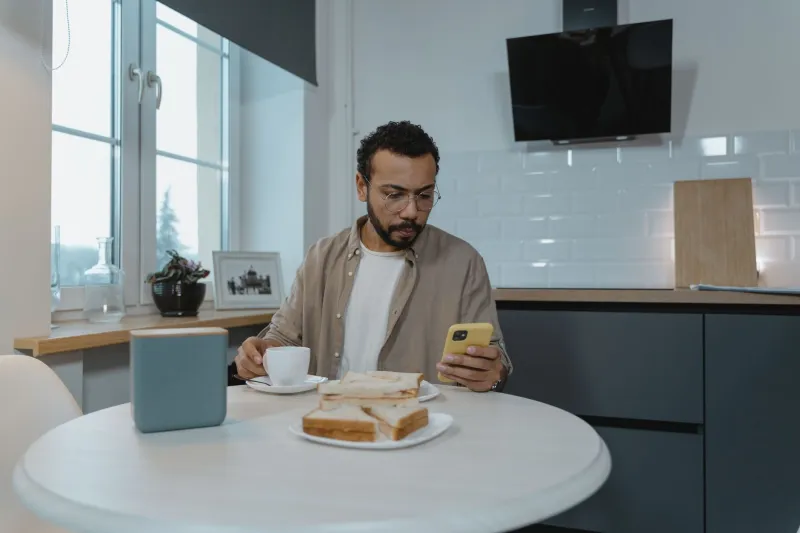
Doomscrolling is not a formal diagnosis, but it describes a recognizable behavioral pattern: repeated checking of news and social media in search of certainty or relief. Research on uncertainty and information seeking helps explain why the pattern persists. Checking can feel like action. It temporarily reduces the discomfort of not knowing. But when the information is ambiguous, threatening, or rapidly changing, checking can increase arousal and make the next check more likely.
A practical question is not whether one is informed enough. It is whether checking is producing useful action or only physiological activation. News boundaries are more effective when they are specific: a set number of check-ins, a defined time window, notifications turned off during meals and the hour before bed, and a clear stopping rule. The point is not avoidance of civic life. It is preventing a 24-hour information cycle from becoming a 24-hour stress cycle.
Co-Rumination and the Group Chat
Co-rumination refers to repeatedly discussing problems with others in a way that amplifies distress rather than resolving it. It can feel bonding, especially when friends or family share political concern. But research on co-rumination suggests that prolonged, repetitive problem talk can deepen anxiety and depress mood, particularly when the conversation circles the same uncertain outcome.
A useful adjustment is to give the conversation a container. A fifteen-minute check-in can be followed by a shared activity, a change of subject, or a practical task. Some people find it helpful to name the difference between processing and spiraling: processing moves toward clarity or action, while spiraling revisits the same threat without new information. Neither approach requires abandoning political values. It requires noticing when support has become a loop.
Sleep Is Biological, Not Partisan
Sleep disruption after an election is common for a simple reason: arousal and uncertainty are not friendly to sleep. Late-night coverage, bright screens, alcohol, and heated conversations can all prolong the feeling of alertness. The evidence-based basics remain unglamorous but effective: a consistent wake time, a wind-down period, dim light in the evening, caffeine limits, and a news cutoff before bed.
It is also worth resisting the idea that one must stay up to prove concern. Sleep is not a political statement. It is a biological process that supports mood regulation, attention, and stress recovery. Protecting sleep in the days after the midterms is a practical way to remain functional for the weeks that follow.
A Practical 72-Hour Reset
A short reset can be built from small, specific steps rather than grand resolutions. First, contain the information stream: choose a limited number of check-in times and keep devices out of the bedroom. Second, schedule a worry or reflection period earlier in the day so that rumination has a place other than bedtime. Third, restore one or two anchor routines—meals, a walk, a consistent wake time, a phone call with a friend. Fourth, set boundaries around co-rumination by naming a time limit or suggesting a shared activity. Fifth, use movement and outdoor time as regulation tools rather than as punishment or productivity metrics.
These steps are not a substitute for political engagement. They are a way to keep engagement sustainable. Research on stress and coping generally supports the value of routine, social support, and controllable action. In the post-election period, the most controllable actions are often small: what time one checks the news, who one talks with, when one goes to bed, and whether one returns to ordinary obligations.
When to Seek Additional Support
It is reasonable to seek help when distress is persistent, when sleep problems continue for weeks, when anxiety or low mood interferes with daily functioning, or when coping involves increased alcohol or substance use. Primary care, employee assistance programs, and licensed therapists are appropriate starting points. Therapy approaches such as cognitive behavioral therapy and behavioral activation have evidence for anxiety and depression, and a clinician can help distinguish ordinary post-election stress from a condition that warrants treatment.
The days after the 2026 midterms do not require a perfect emotional response. They require a workable one. A nonpartisan plan for political stress is not about withdrawing from public life. It is about protecting the sleep, attention, and relationships that make sustained civic participation possible.